How to Rehab a Shoulder Injury Safely: Physiotherapy Essentials
Shoulder injuries can be frustrating, especially when they interrupt your gym routine or active lifestyle. Fortunately, with the right shoulder injury treatment, rehab exercises for shoulder injury, and physiotherapy guidance for shoulder pain, you can recover safely and get back to doing what you love. Here’s everything you need to know about shoulder rehabilitation.
This article is primarily for people who want to recover from their shoulder injury as soon as possible and are looking for the best possible way to heal with the help we provide at Healthy Movements Physiotherapy.
Shoulder Injury WARNING SIGNS
As soon as you notice intense shoulder pain, difficulty performing everyday activities, swelling, tenderness to the touch, and your condition getting worse day by day, do not wait!
The sooner you take action and begin the recovery process, the better the results will be. So don’t wait and don’t hesitate! – Contact us as soon as possible so we can help you start your recovery right away.

Shoulder joint and rotator cuff muscles
- The shoulder is a ball-and-socket joint (articulatio humeri), making it the most mobile and most complex joint in the human body.
- It consists of the head of the humerus (on the upper arm bone) inserted into the glenoid cavity (a socket on the shoulder blade).
- Due to its structure, movements are possible in all directions, which means it has a large range of motion and movement in all directions, but also makes it a very unstable joint.
The rotator cuff refers to a group of muscles that originate from the scapula and insert onto the prominences of the humerus. These muscles include:
- Subscapularis – responsible for internal rotation of the arm
- Supraspinatus – helps maintain the humeral head in the glenoid cavity, tightens the joint capsule, and abducts the arm
- Infraspinatus – reinforces the shoulder joint capsule and primarily functions in external rotation of the arm
- Teres minor – a weak external rotator of the arm

Pain in the shoulder can stem from overuse, repetitive strain, or poor posture.
Physiotherapy for shoulder tendonitis includes manual therapy, strengthening, and mobility exercises.
This diagram highlights the common structures affected in shoulder pain conditions.
The primary function of these muscles is the dynamic stabilisation of the shoulder joint, meaning they ensure the position of the humeral head within the relatively shallow socket of the scapula during movements that involve the large muscles of the chest and upper back.
Other muscles, such as the deltoid, teres major, coracobrachialis, latissimus dorsi, and pectoralis major, also contribute to shoulder stabilisation.
Rotator cuff injuries
- In 90% of cases, the tendon of the supraspinatus muscle is injured, either on its own or in combination with an injury to the infraspinatus tendon.
- Damage to the rotator injury cuff causes pain, limited mobility in the shoulder joint, loss of smooth motion (the shoulder “catches” or “jumps”), and can lead to the development of arthritis and calcifications in the shoulder joint.

The supraspinatus, infraspinatus, teres minor, and subscapularis muscles are key components of the rotator cuff.
Pain may be felt in the front or back of the shoulder depending on which tendon is affected.
Physiotherapy helps to reduce inflammation, restore range of motion, and strengthen shoulder stability.
Causes of Shoulder Injuries at the Gym :
Acute Injury Causes
- Occurs when lifting an excessively heavy load that the muscles and tendons cannot withstand, or from a direct fall onto the shoulder.
- A sharp pain appears in the front and back of the shoulder, radiating toward the elbow, accompanied by a reduced range of motion in the shoulder due to pain and muscle spasm.
- It may prevent arm abduction and cause weakness in the shoulder and arm muscles.
- It is necessary to reduce or prevent swelling, which can be achieved through rest and applying ice (15 to 20 minutes, 3 times a day).
- Wearing a brace can help offload the shoulder joint, but it should not be used for too long, as this may lead to a decreased range of motion in the shoulder.
- Once the severity of the injury is determined, a targeted treatment approach is taken.

2. Chronic Overuse Injuries
- It occurs in individuals and athletes whose job or chosen sport requires frequent lifting of the arm above the head.
- Repetition of these movements, combined with the lack of compensatory corrective exercises, is the main cause of chronic overuse of the rotator cuff muscles and tendons.
- Arm movements are generally possible, but movements above shoulder height or to the side (abduction) cause pain.
- The pain tends to worsen at night and can wake the person from sleep.
Degenerative Conditions
- It occurs in older individuals at the point where the tendon attaches to the bone. It is more common in women between the ages of 35 and 50.
- Deep pain appears in the shoulder, on the outer side of the upper arm (deltoid). A point of tenderness and pain may also develop above the area of injury.
- Pain intensifies during abduction and internal rotation.
- The condition can become chronic when the tendon becomes so inflamed that blood circulation is disrupted, leading to the death of tendon fibers, which can result in partial or complete tendon rupture.
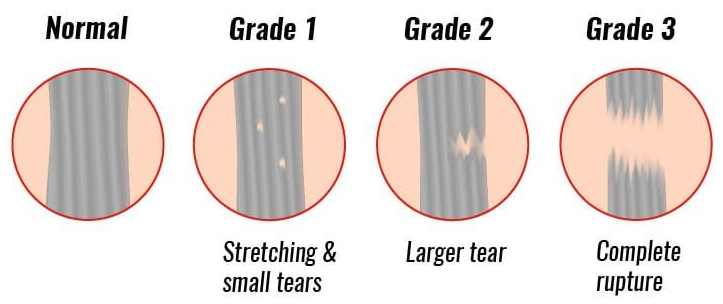
Causes of rotator cuff injuries based on the degree of injury:
- Grade I – Tendon strain
- Grade II – Partial tear
- Grade III – Complete tear
Shoulder Injury Rehabilitation program and plan
- The shoulder rehabilitation program must be tailored to the specific injury of the individual.
- This is a general rehabilitation plan that provides a wide range of exercises for rotator cuff injury and Shoulder Sprains, for optimal rotator cuff and ligament recovery.
- Consult with a Healthy Movements Physiotherapy to determine which physiotherapy shoulder exercises are appropriate for your condition.
- At our clinic, we strive to do this in the best possible way. Here, we provide examples of strengthening and stretching exercises that you can perform, with of course, our assistance.
- Of course, with our help, you will learn how to prevent shoulder injury at the gym and also learn what your movement should look like during your gym workout after a shoulder injury.
5 SIMPLE HABITS TO AVOID SHOULDER RE-INJURY:
- Warm Up Properly Before Any Activity
- Strengthen the Rotator Cuff and Scapular Muscles
- Maintain Good Posture Throughout the Day
- Control the Weights and Progress Gradually
- Stretch and Mobilise Regularly
1.Warm-up
- Before starting your exercises, make sure to warm up for 10 to 15 minutes to stimulate overall circulation and prepare the body.
Swinging
- Let your arm hang freely. From this position, perform swinging movements left to right, forward to backward, and make circles in both directions.
QUICK TIP: Applying ice for 15 minutes three times a day can significantly reduce swelling in the first 48 hours after injury.
2. Strengthening exercises
One Arm High Cable Row
- From a kneeling position in front of the pulley cable, grasp the handle attached to the high pulley cable one hand.
- Keeping your body upright and your elbow close to your body, retract your shoulder blade and in one explosive movement, pull back.
- Squeeze at the peak contraction before returning the weight to the start position.
- Allow the weight to pull you forward slightly before pulling back for another repetition. You can step forward with the opposite leg for support when working with heavier weights.
Single Arm Rows
- Start with your feet hip width apart, and hold a dumbbell in your (right or left) hand. Bend over at a 45 degree angle and make sure to keep your back neutral (not arched or rounded) with your core engaged.
- Keep your chest up, your shoulders pressed down, and your chin lifted.With your other hand on your upper thigh, engage your abs and squeeze your shoulder blades together as you lift the (right or left) arm towards your torso.
- Keep your elbows pointed upward! Slowly lower the weights back to the starting position to complete one rep.
Internal Shoulder Rotation with band
- Begin with one end of the band securely attached at waist-height. (You may place a towel roll under your arm as well.)
- Grasp the other end of the band with tension.
- Pull the band away from the wall, rotating your forearm inward.
- Hold and slowly return.
- Be sure to keep your forearm parallel to the ground, your elbow by your side, and your wrist straight.
External Shoulder Rotation with a band
- Begin with one end of the band securely attached at waist-height. (You may place a towel roll under your arm as well.)
- Grasp the other end of the band with tension.
- Pull the band away from the wall, rotating your forearm outward.
- Hold and slowly return.
- Be sure to keep your forearm parallel to the ground, your elbow by your side, and your wrist straight.
Side-Lying External Rotation
- With a light dumbbell or weight (5 pounds is ideal) in your left hand, lie on your right side with a rolled towel under your left elbow.
- Bend your right arm and rest your head on your right hand or a pad.
- Bend your left elbow 90 degrees and rest the weight in front of your stomach.
- Don’t bend your wrist.
- Keep your left upper arm at your side as you rotate your forearm to raise the weight until it’s above your body.
- Slowly return to the starting position.
QUICK TIP: Always focus on your proper form when you perform these exercises, always with a full range of motion.
3. Stretching exercises
Cross-body reach
- Sit or stand.
- Use your good arm to lift your affected arm at the elbow, and bring it up and across your body, exerting gentle pressure to stretch the shoulder.
- Hold the stretch for 15 to 30 seconds.
Pectoralis Major Stretch
- Place your arm against a wall to stretch one pec at a time.
- Stand in a doorway or at the end of a wall in a split stance with one leg in front of the other.
- Your forward foot should be the one farthest away from the wall.
- Place your hand and forearm against the wall with your elbow at a right angle so that your forearm is perpendicular to your body.
- Press your chest through the open space until you feel a stretch. Hold the stretch for 15 to 30 seconds, breathing deeply.
Shoulder Internal Rotation Towel Stretch
- Place a towel behind your back
- Hold it diagonally with one arm at the top behind your shoulder and the other arm grabbing the bottom at your waist
- Flex the elbow down and pull with the bottom arm
- Do not hold the stretch – moving up and down is key, giving it a nice stretch
QUICK TIP: When you are doing stretching, always focus on holding for 15-30 seconds and also on proper breathing during the stretch.
WHAT TO EXPECT IF YOU DO THESE EXERCISES 3-4 TIMES A WEEK?
- If you perform these exercises regularly, meaning 3–4 times per week, you can expect steady progress day by day.
- As you continue, your shoulder muscles will become stronger, your shoulder mobility will improve, your range of motion will be restored, and the pain you’re currently experiencing will gradually disappear.
- This process also teaches you discipline, encouraging you to stay more active throughout your life and reminding you that movement-based recovery is always the right choice.
TREATMENT CONCLUSION
- These are just some of the exercises that can help you in your recovery.
- At Healthy Movements Physiotherapy , we offer many more exercises as well as proper education on exercise execution.
- We also provide supervision while you perform the exercises, correcting your form, because the most important thing is to have someone experienced and knowledgeable guiding you.
- That’s exactly what our team does — we support, teach, and guide you toward a faster and more effective recovery.
- So don’t hesitate and don’t wait too long! — Ready to recover and move freely again? Contact Healthy Movements Physiotherapy today and let’s plan your personalised rehab journey. Book now, why stay in pain?
Solder Rehab Frequently Asked Questions (FAQs) About
Most shoulder injuries recover within 6–12 weeks with consistent physiotherapy, but timelines vary depending on severity.
Strengthening exercises like internal/external rotations and scapular stabilisation drills are essential. Always start under supervision.
Yes, but gradually. A physiotherapist can guide you on safe progressions and gym modifications. We can also go to the gym with you, just ask!
Symptoms include pain with overhead movement, night pain, and weakness when lifting your arm. Physiotherapy assessment can confirm this.
No referral is needed to book an appointment at Healthy Movements Physiotherapy — just contact us directly.