Had a stroke? we’ve seen first-hand how the recovery process can feel overwhelming. If you’re looking for exercises to get started towards building strength and confidence, the moves covered in this article are a great starting point. However, you don’t have to navigate Stroke recovery alone. Our physiotherapists guide stroke survivors like you make strides everyday.
A Stroke occurs when there’s a disruption of blood supply to some parts of the Brain. This leads to oxygen deprivation and death of nerve cells in the affected Brain regions. Consequently, functions which are controlled by those parts of the Brain get impaired, causing a certain degree of disability. Physiotherapy is an essential part of Stroke recovery, aimed at restoring lost physical functions through a comprehensive physical rehabilitation porogram.
At Healthy Movements Physiotherapy, we emphasise that the rehabilitation program should begin as early as possible and should be carried out by a multidisciplinary team of professionals (doctor, physiotherapist, speech therapist, etc.). The patient’s family should also be involved in the rehabilitation program, as this greatly contributes to their motivation and recovery.
“Daily exercise helped me get back to the life I had before my stroke. The team at Healthy Movements Physiotherapy helped me regain my abilities just as they were. That’s why I highly recommend taking your stroke recovery exercises seriously.” (Maria)
Role of Physiotherapy in Stroke Recovery
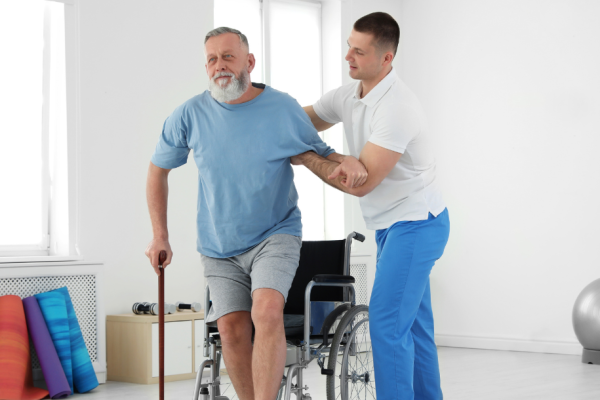
Physiotherapy interventions after a stroke may include various treatment approaches/methods depending on the patient’s condition.
Special exercise concepts are implemented with an emphasis on targeted active movements. These include Proprioceptive Neuromuscular Facilitation( PNF), Bobath, Mirror Therapy, Constraint-Induced Movement Therapy and others.
These interventions are based on the fact that active movement leads to Brain adaptations necessary to regain function. This is derived from the principle of neuro-plasticity, which suggests that healthy parts of the Brain take over the functions damaged areas affected by the stroke (the so-called “Use it or lose it” rule).
Exercises actively stimulate or facilitate muscle function, improve posture, movement, coordination, and balance, while also reducing the occurrence of pain and spasticity.
The patient’s abilities are improved, movements and daily living activities are relearned with the goal of achieving functional activity that allows the patient to live a better quality of life.
“Every patient after a stroke has the potential for recovery; however, the battle for recovery is a daily one, lasting every day of the week.” Marco
Starting Smart: Navigating Gym Rehabilitation After Stroke with the Right Support

The highest quality of recovery is achieved within one year (worldwide emphasis is on the first three months).
During this period, it’s easier and more effective to promote creation of new pathways in the Brain. However, these changes can take place even after this period, including several years after the stroke. That’s why post-stroke strength training continues even after the initial critical period.
Every patient after a stroke has the potential for full recovery, but few actually reach it. The battle for recovery lasts all day, every day of the week.
Therefore, it’s by no means limited to the time spent in rehabilitation centers or during visits with a physiotherapist. It’s also important that the patient repeats learned activities and exercises assigned by the physiotherapist several times a day and does as much as possible independently: dressing and undressing, cooking, eating, hygiene, etc. The patient’s motivation and desire to become an active member of society again are the most important parts of recovery.
As the patient experiences improvements in movement and body sensation, motivation grows and recovery speeds up.
“Why Strengthening Matters After Stroke”, “Top 10 Physiotherapist-Approved Exercises”
- It’s best to start the exercises by focusing on your breathing.
- Starting position: lying on your back, knees can be bent or straightened (depending on what is easier). Place your palms on your abdomen.
- Keep your arms and shoulders relaxed. Inhale gently and slowly through your nose.
- Exhale through your mouth while making the sound of the letter S or F (try to create some resistance by exhaling through your teeth or pursed lips).
- During the exhale, try to feel your abdomen tightening under your hands and gently lowering toward the surface.
“Always consult with your physiotherapist before attempting new exercises, especially after a neurological event like a stroke.”
Affected Arm Weight-bearing
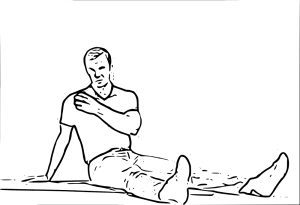
While sitting on the floor or at a table. Feel the weight on that arm, trying to maintain the position of the affected arm while simultaneously raising the healthy arm above your head. Keep your eyes on the affected arm the entire time.
Watch out for:
• Loss of focus on the paretic arm → it may “drop”
• Inability to maintain a passive position. You may need help if that’s the case.
Front Raises

- Sit on a chair or bench. Feet at Shoulder width apart.
- Clasp your hands, and stretch both arms forward. Use the unaffected arm to help with achieving full elbow extension in the affected side.
- Raise both arms as far up as you can. Try to get both hands directly above your head.
- Return to the starting position.
- Repeat the movement 10-15 reps, 3-4 sets .
Progression:
- Try to perform the movement in standing position.
- Add task targeted movements for an extra layer of complexity.
Things to watch out for:
- Asymmetrical execution (the healthy arm “pulls” the entire movement).
- Shoulder pain due to poor scapular control.
Lower your arms toward your feet
While sitting with both feet firmly on the ground. On an inhale, lower your arms toward the healthy side’s foot (as if you are going to tie your shoelace). On an exhale, return to the starting position and repeat the same movement toward the affected side’s foot.
Progression:
- Arms in the air, then bending
- Perform from a standing position.
Things to watch out for:
- Loss of balance when bending toward the affected side.
- Body compensation (twisting, flexion).
Hold a bottle or glass with both hands
Lift it, hold the position, and try to drink or move the bottle on the table.
Progression:
- Less assistance from the healthy hand.
- Heavier object Difficulty: Grip is not full → risk of dropping.
Weight-shifting in Standing
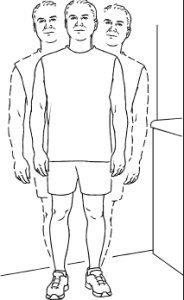
With your feet hip-width apart. You can hold onto a support. Feel how you slowly shift your weight from one foot to the other, moving left-right and front-back. Once you have mastered this, shift the weight from the healthy heel toward the toes of the affected side and assume a stepping position.
Progression:
- Without support.
- Weight shifting on unstable surfaces
Look out for:
- Fear of falling because of stiffness.
- Asymmetrical weight shift
Leg Lifts
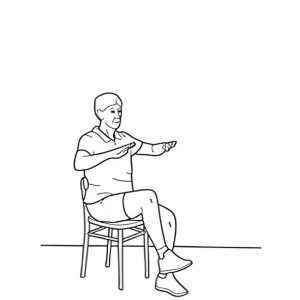
On the edge or backrest of a chair. Sit upright with both feet firmly on the floor. Stabilize your torso and on an exhale slowly lift one leg off the ground (the movement should come from the hip). On an inhale, return the leg to the floor and repeat the same with the other leg.
Progression:
- Add some weights on the ankle.
- Hold leg in the air for more seconds.
What to watch out for:
- Movement goes from the back instead of the hip.
- Insufficient body control
Step Ups
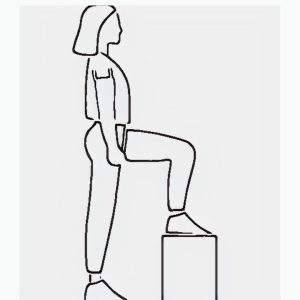
Lift the affected leg onto a step while supporting yourself with the healthy hand, then return it back. Next, step up onto the affected leg with your body leaning forward as much as possible. Once you master this, take a step with the healthy leg onto the next step.
Progression:
- Higher step
- Without support
What to watch out for:
- Fear of falling → movement becomes unsteady.
- Poor knee control (knee must go inward).
Steppping
Take a step forward with the healthy leg, then return to the middle position or, if you can, behind the affected leg. Try to feel the muscles around the hip.
Progression:
- Without support.
- Adding movement with the healthy leg (tapping forward and backward).
Watch out for:
- Foot drag.
- Compensating with excessive pelvic tilting.
Foot Slides
Place paper or something similar under your foot to make sliding easier and imagine you are cleaning the floor while standing on one leg. Repeat with the other leg.
Progression:
- Standing on one leg while the other leg is in the air and do same without paper
- Larger range of circular motion.
What to watch out for:
- Instability on the supporting leg.
- Insufficient load on the paretic leg.
Reverse Walks
While holding onto a table, railing, or similar support.
Progression:
- Without support.
- Walking backward on a line.
What to watch out for::
- Loss of orientation.
- Steps too large or too fast → loss of balance.
Start Your Recovery with Healthy Movements Physiotherapy: Stroke Rehabilitation Specialists in Western Sydney
- At Healthy Movements Physiotherapy, we understand that every step toward recovery is a victory.
- We offer in-gym physiotherapy sessions, where stroke survivors are supervised while using strength equipment.
- Each stroke client gets an individualised exercise program, and because not every exercise suits every person, we use tools like resistance bands, pulley systems, and gym machines, adapting to the patient’s stage of recovery.
- Don’t let pain or limitations hold you back. Take the first step with us and experience compassionate care tailored specifically to your needs.
- Your journey to healthier, more independent movement starts here—book your consultation today and let us help you move better, live better.
Frequently Asked Questions
Can I go to the gym after a stroke?
Yes, with the right support. At Healthy Movements Physiotherapy, we help stroke survivors safely return to the gym using tailored strength programs guided by experienced physiotherapists.
How soon after a stroke should I start physiotherapy?
Ideally, as early as possible. However, even months or years after a stroke, strength and function can continue to improve with targeted physiotherapy.
What kind of exercises help with stroke recovery?
Strengthening exercises that target balance, coordination, and movement—especially ones guided by physiotherapists—are effective for stroke recovery.
Do I need special equipment for these exercises?
Many can be done with everyday objects or simple equipment, but at our clinic we also offer gym-based rehab using resistance machines, steps, and weights.
Is neurological physiotherapy covered by NDIS or insurance?
Yes, in many cases. We are NDIS registered and can help guide you through your options for coverage and funding.